Baykeeper Board of Trustees announces the appointment of Debbie Mans as Andy Willner's successor
Posted 03/17/2008
The following is a transcript of the speech given by Andy Willner at the Founder's Fete, March 12, 2008.
Thank you Bobby, thank you for your leadership, your friendship, and inspiration. Thanks to everyone who helped put this amazing event together. Thanks also to my family for being here, to all the people I’ve worked with for nearly two decades, and to you my friends for sharing this evening with me. I want to recognize two special people, John and Wendy Neu, who have been supporters and special friends to Baykeeper and to me, I am excited about working more with both of you. Thank you Ben, and the rest of the Baykeeper Trustees, and Senator Menendez, and thank you, all of my Waterkeeper colleagues who are here tonight and those who have sent heartfelt messages.
Anyone who knows me also knows I love to tell a story, and since this is one of my last opportunities as Baykeeper, I thought I would just tell a little part of the Baykeeper story, how it all began, gained momentum, and flourished, and how we wound up as the vital organization we are today.
I also want to tell a little bit about how I find myself standing here tonight. I owe a lot to my parents. My mom was, and still is, an artist. She taught me how to look at a problem, break it down into its component parts, and put those pieces back together to create new and exciting solutions. That intuitive mode of thought has paid huge dividends as Baykeeper has devised innovative answers to seemingly unsolvable questions.
My dad was a physician and linear thinker. While he failed to instill his methodical approach to life in me, he did provide an extraordinary model for living an ethical life – another essential trait for a Baykeeper.
I am also very lucky to be in love with and married to Jo-Ellen, who reminds me who I really am when my head gets too big. And then there’s Emily, my daughter and my joy. She followed in my dad’s footsteps, and became a physician. And as you will hear shortly, it was a much younger Emily who inspired me to set out on my voyage as Baykeeper.
Over the years, I’ve also had amazing friends, advisors, supporters, mentors, and colleagues, some of them sitting in this room, who taught me, let me emulate them, and later make what they taught me my own.
I have to be honest with you. I didn’t grow up loving the Bays of New York Harbor. I had to learn how to care passionately for this scarred but unbeaten ecosystem.
My first recollection of the Harbor, its waterways and wetlands, while growing up in northern New Jersey, was of smell and smoke. To get to New York City in the 1950’s meant driving the Pulaski Skyway. Traveling that road, particularly at night suggested Heronimous Bosch images. Windowless factories spewed fire, smoke, and repulsive odors. The ride always evoked squeals of horror and delight from the back seat of my father’s Oldsmobile as we entered the aroma zone of the Secaucus pig farms, and the burning garbage dumps.
My earliest activism came in high school when my friend David and I, wearing berets and with what little facial hair we could muster, attended SANE nuclear policy meetings at the Ethical Culture Society, mostly because we had heard that the “beatnik chicks” might be easy.
Then in 1970, at the moment Nixon invaded Cambodia, and with TV images of dead college students at Kent State, my opposition to the war and my life in advocacy truly began. This soon led me to early efforts to save two living rivers: to help to stop the building of the Tocks Island Dam on the Delaware, and the construction of nuclear power plants on the Susquehanna.
Much later, in the 1980’s, after I had returned home, I worked as a wooden boat builder and restorer on Staten Island, just above the Narrows. Three experiences convinced me then that the battered bays of the Harbor needed a Keeper.
• A much younger Emily came to play in the boatyard. On the hottest summer days I filled an old fiberglass dinghy full of tap water so she could splash and cool herself safely. It was both poignant and pitiful that we couldn’t walk half a block to the beach, and swim in the Harbor. That the closest bit of sand was called “needle beach” was also a strong deterrent.
• The second experience happened when a huge fish, a prehistoric-looking sturgeon, lazily swam in and out of the boat basin. I watched its every move with wonder. Just as at other times I watched herons hunt killie fish in the shallows adjacent to the half-sunken wooden barges in the mud flats of the Arthur Kill.
• The third catalyst to my advocacy came when I started hearing about Riverkeepers on the Hudson and Delaware, a Long Island Soundkeeper, and a Baykeeper in San Francisco.
I was inspired by what was happening almost in my backyard. Bob Boyle (and his book about the Hudson A Natural and Unnatural History), John Cronin the Hudson Riverkeeper, Pete Seeger and Clearwater; the Hudson River Fishermen’s Association, Scenic Hudson, commercial and recreational fishermen, and thousands of community members who had joined forces to launch a grassroots revolution. They reclaimed the Hudson River as their own, despite its being used as an open sewer, and being abandoned by the state and federal governments. The miracle was that, thanks to these caring advocates, the Hudson was healing.
I pestered John Cronin and Terry Backer the for months as I became determined to emulate their work in the Bays of New York Harbor. In August of 1989, with encouragement and a contribution from Riverkeeper and the American Littoral Society, Baykeeper was born.
Our baptism was in oil. On New Years Day, 1990, Exxon spilled 500,000 gallons into the Arthur Kill, a tidal strait separating New Jersey and Staten Island. I called Dery Bennett the Littoral Society director and asked him, “What do we do when something like this happens?” He responded, “I don’t have a clue, go figure it out.”
So I made it up as I went along. I went to the only accessible waterfront on the Arthur Kill. I literally moved TV news cameras toward me, and began to speak. To my surprise the reporters listened.
When Exxon claimed that the Arthur Kill was a lifeless waterway that couldn’t be harmed by the oil spill, friends and I gathered up dead, oil-soaked birds in an attempt to force the company to tell the truth. When an Exxon guard asked me by whose authority I was ordering him to open the refinery gate to admit a pick-up truck loaded with oiled casualties, I whipped out my only identification, a Hop-Along-Cassidy badge and said, “Because I am the Baykeeper!” I told him if he didn’t let me in, I would dump those dead birds in the lobby of the New York Times. After consulting with his boss, the guard let us in to the bird rehabilitation center where the victims could be added to the total killed, and later I did get my interview with the Times.
During the Exxon spill I learned on the job, about how oil doesn’t get cleaned up, despite what the Coast Guard says - that birds and fish are affected years after a spill, and that salt marshes, notwithstanding their tenacity, are killed by oil.
I also learned how to sit through interminable meetings, to understand the insults to the environment hidden in bureaucratic jargon. And I learned how to take advantage of my place at the table. I also discovered that reporters and agency personnel, like everyone else, become advocates if you can just get them out on the water.
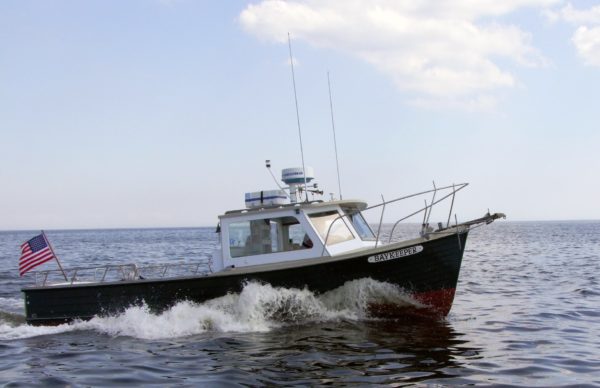
I made the boat a tool as well as a symbol. I learned to be a loving guide, to show people beauty beyond the tragedy, and to make the Arthur Kill a symbol for positive change throughout the Bay.
I learned quickly that I did not know much, and that others with years of experience were willing to teach me. And I also found that assertiveness, bordering on aggressiveness, can serve the cause as long as it is tempered with information both accurate and consistent. The baptism of Baykeeper, in the oil of the Arthur Kill Spill, was a great first lesson in the sobering reality of urban environmental advocacy.
During the early 1990’s, my passion for my Bays, my home, became both professional and deeply personal. The Harbor, I learned, is a productive ecosystem, boasting hundreds of species of plants, fish and other wildlife – and that a lucky wanderer can still explore quiet sandy beaches, fresh and salt-water marshes, rocky points, broad bays, and narrow straits. There are very few places like our Estuary, where a fisherman could have a day like I had during a summer now ten years ago - a home run: a striped bass, a huge summer flounder, a weakfish, and a bluefish, all caught in Raritan Bay. (on the same tackle and within a half mile).One of Baykeeper’s strengths has always been “wiseassiness,” and I think that is a great description. Baykeeper has always been a first responder. When everyone else is running away from the toughest issues, we’re running toward them, licking our chops and rubbing our hands. Over the years, that has meant that we’ve worked hard to prevent:
• the loss of our last urban open spaces to development;
• the loss of wetlands in the Meadowlands, Jamaica Bay, Raritan Bay, and the Kills;
• the failure of government to press for Natural Resource Damages from our worst corporate polluters;
• storm water pollution and the disgrace of combined sewer overflows;
• nitrogen pollution from New York City;
• dioxin pollution on the Passaic; and PCB pollution in the Harbor. --
Hardcore advocacy has always been the defining feature of Baykeeper’s work. We love a good fight, even if some take decades to resolve. We especially enjoy a brawl in which the odds are stacked against the people and the environment, in which bad guy developers and polluters smugly assume victory because of their bloated wallets and backdoor political influence.
I’d like to focus on just two of those David and Goliath fights: one on the Hackensack in which we, along with a remarkable coalition, achieved a major triumph, and the other on the Passaic and in Newark Bay which is ongoing.
There’s little question that one of Baykeeper’s greatest victories and environmental legacies to date is on the Hackensack River in the Meadowlands. From the start we drew a line in the marsh that we would not allow developers to cross. We said that not one acre of wetlands would be filled in, and we stood by that declaration for more than a decade. We galvanized the public by showing again and again how stupid these proposals to fill some of the region’s last wetlands really were. Ultimately 10,000-plus advocates preserved over 8,000 acres of wetlands within five miles of New York City, and put citizens back in the driver seat to manage those precious natural resources. Of course the satisfaction of winning that fight, with our own Billy Cahill, Ed Lloyd, Susan Kraham and the Rutgers Environmental law clinic, and our closest ally Bill Sheehan, is indescribable.
We’re still fighting another decades-long campaign on the Passaic River against Occidental Chemical – one of the region’s and the globe’s most heinous polluters.
A single Newark factory stands out for its deadly products and pollution, and for its shameful history on the Passaic. Diamond Alkali manufactured DDT and Agent Orange, and for years, they dumped a deadly dioxin cocktail into the waterway.
Because of these barbaric practices, both the factory and Passaic River were declared federal Superfund sites. But as of today, almost 25 years later, the USEPA has done nothing to force Occidental Chemical (The successor to Diamond’s businesses and liability), to clean up the River and Newark Bay.
Their dioxin has concentrated in the region’s fish and crabs. It is also concentrating in the fat, breast milk, and reproductive organs of fishermen, their families, and those who just happen to live along the Passaic. The dioxin mimics hormones, breaks chromosomes, and raises havoc in our bodies.
Despite more than 15 years of advocacy in which Baykeeper has clearly documented Occidental as the villain with the largest liability on the Passaic, the polluter concocted its own absurd proposal for clean up. Remarkably, this bogus initiative puts two of the most compromised federal agencies, the USEPA and US Army Corps of Engineers in charge of the clean up. The Bush EPA is a toothless tiger, and The Corps of Engineers, the other key player in the Initiative is worse. Not surprisingly, Baykeeper, Green Faith, and the Natural Resource Defense Council were forced, nearly four years ago, to bring legal action against the Corps, a case we won.
Only public outrage and local advocacy against Occidental’s egregious dioxin pollution has so far resulted in decisive action. Only when Baykeeper, Hackensack Riverkeeper, and NRDC gave notice to Occidental of our intent to sue for "imminent endangerment" of human health and the environment did the EPA finally compel Occidental to pay for and expand the Superfund study area to include Newark Bay. We proved decisively in that moment that local muscle does work.
It became apparent to us early on that we would have more credibility as advocates if we didn’t just battle the bad guys, but also were pro-active problem solvers. That’s where our policy, land conservation, and oyster restoration programs come into play.
Law suits against operators of out of compliance combined sewers; against land owners preventing public access to our region’s beaches and shorelines here along the Hudson, and owners of contaminated land polluting our local waterways set the stage for our most important policy initiatives.
Our Policy program has had significant impact on the Estuary –
• by giving people tools to understand their ownership of natural resources through our resurgent use of the Public Trust Doctrine
• by changing public policy in both states through our Brownfields to Greenfields initiative,
• and most recently Betsy McDonald has provided decision makers the tools to deal with storm water and combined sewer overflow pollution though our work on Low Impact Development, a lower cost, low tech, green solution,
Greg Remaud has almost single-handedly turned our organization into a force to be reckoned with in urban land preservation.
Today, as a result of Greg’s work, Baykeeper is a true partner with New Jersey’s Green Acres program, the Port Authority, local communities, and urban open space advocates in finding the funds, and facilitating the transfer of important urban habitats from private to public management.
One day on the boat with a much younger Ben Longstreth, I looked at a chart of the Navesink River, and saw that we were off Oyster Point in Red Bank. I mused to Ben, “Let’s get oysters back at Oyster Point.” Ben not only took me seriously, but the program he started is now 400-volunteer oyster gardeners strong, overseen by Meredith Comi, it is a bi-state program with oyster reefs restored, and a large scale benthic habitat restoration project on the way. Thanks to a million dollars from a Supplementary Environmental Project.
Another accomplishment I am most proud of is that Baykeeper is a founding member of the international Waterkeeper Alliance. Keepers are stubborn and audacious. Good traits in a fight with polluters, but sometimes hard on the digestive system. When in 1994 seven of us tried to figure out how to form a national alliance of River, Sound and Bay Keepers, sometimes we drank more Maalox than beer. But John Cronin, Terry Backer, Cynthia Poten, Mike Herz, Kenny Moser, Joe Payne, and I continued to come together in sometimes raucous, always exhausting meetings and had the impudence, the audacity, to start a national organization.
That dream, mid-wifed by John Cronin and Bobby Kennedy, and formalized in 1999, has since become the Waterkeeper Alliance, a worldwide movement of more than 170 Waterkeepers. We started with a simple idea that continues to be our rallying cry today:
Our Rivers, Bays, and Sounds are the largest thing we will ever own.
Water belongs to all of us and it is our right and responsibility to care for it.
Everyone has a right to use our commonly owned natural resources, but no one has the right to use them to the detriment of anyone else.
The odds Waterkeepers face – small groups against huge polluters and reluctant, sometimes maleficent governments – are daunting. But our unique unifying strength as a movement arises from the very fact that we love such David and Goliath challenges. It’s what gets us up in the morning, into the meeting rooms, and out on the water. It’s also what makes it possible for a Waterkeeper in China, or Utah, Columbia, Canada, or India able to stand up and say I am the Waterkeeper, and people listen, and things change.
I would like to close with a literary reference. Shakespeare’s St. Crispian’s speech, written nearly two hundred years after the Battle of Agincourt, remains one of the finest dramatic interpretations of what courage means. Morale in the English line, as the troops looked upon the overwhelming force of heavily armored French knights, was extremely low on that day. King Henry, rising to the occasion, spoke words of encouragement that rallied the English troops and carried them to victory. Although Shakespeare’s speech is a work of fiction, it is evocative of the spirit that enables a small group of committed people to prevail through the strength of their convictions. In part it reads:
He that shall live this day, and see old age, will yearly on the vigil feast his neighbours, And say 'To-morrow is Saint Crispian.' Then will he strip his sleeve and show his scars, and say 'These wounds I had on Crispian's day.' Old men forget, but he'll remember, with advantages, what feats he did that day. Then shall our names, familiar in his mouth as household words- be in their flowing cups freshly rememb'red. This story shall the good man teach his son; From this day to the ending of the world, but we in it shall be remembered - We few, we happy few, we band of brothers; For he to-day that sheds his blood with me shall be my brother; This day shall gentle his condition; And gentlemen in England now-a-bed Shall think themselves accurs'd they were not here, and hold their manhoods cheap whiles any speaks that fought with us upon Saint Crispin's day.
Baykeeper – its vital staff, its engaged board, its hundreds of volunteers and supporters, have faced a number of St. Crispin’s days together. So it is important, when we gather to celebrate our victories that we pull up our sleeves and show our scars, and salve our wounds, share our stories, and in our flowing cups freshly remember.
And in a hundred years, when a yet to be born Shakespeare tells Baykeeper’s tale, she may not remember our names, but she will recite our deeds – that although we few, we band of brothers and sisters, didn’t daily face an overwhelming army, we fought battles even more meaningful. We fought for the very life of our Bays, for people’s rights, for our community, and for the preservation of our blue-green Estuary.
It has been my privilege to serve. And I pledge, from tonight forward, to continue to stand with you, together as friends of this special place, of our wilderness in the city. And I know you will stand with Baykeeper in whatever battles loom, to protect our living waters – our bays, rivers, and marshes.
Tonight has been remarkable. Thank you all for the kind words. I can’t wait to see what happens next with Debbie at the helm. I have never been so proud, so full of love, for a most singular group of people, the most unique, the most important, the most relevant, the most competent, the most caring and effective organization in the region, perhaps the nation – Baykeeper. Thank you.
|
 |


Senator Robert Menendez with Andy
|